Alphabet · Explanatory Note · Q3 2026
Alphabet: An Investor's Explanatory Note
November 2026. The five parts of the financial analysis, retold in plain language: what this business is, what it owns and owes, how much cash it earns, what makes it strong, what puts it at risk — and the price at which it is sensible to buy. Accounts as at 30 September 2026; share price $279.84; 10-year US Treasury yield 4.93% (2 November 2026).
Contents
This note is written for a reader who is under no obligation to understand accounting but wants to know what he is buying. We try to write the way we would want others to write for us: without jargon, with figures only where they are needed, and with a straight answer to the question that matters — is this company worth buying now and, if not, when?
Alphabet is one of the finest businesses money can buy on a public market. It earns almost half a trillion dollars a year, grows by a quarter annually, and does so at margins most companies can only dream of. But in 2026 it placed the largest bet in its history: it is building computing capacity for artificial intelligence faster than it earns money from it, and borrowing the difference. At today’s price the buyer of the share pays for the success of that bet in advance. We would gladly own Alphabet — but we would rather buy it cheaper, and below we explain why that chance may yet come.
There is a well-known Buffett principle: it is better to buy a wonderful company at a fair price than a fair company at a wonderful price. Alphabet is beyond argument a wonderful company. The question this note asks is whether the price is fair.
What kind of business is this?
Picture a toll road used by several billion people every day. For them the road is free; the toll is paid by those who want a billboard at the roadside. That is Google. A driver searches for “windscreen replacement”, and repair shops bid in an instant auction for the right to show him their advertisement. They pay only when he clicks on it. That is why search advertising is the most effective in the world: the customer has already said what he needs.
Four more businesses have grown up around this road. YouTube — advertising shown before videos, and paid ad-free subscriptions. Subscriptions, platforms and devices — Google One (storage and AI plans), YouTube Premium, the Google Play app store, Pixel phones. Google Cloud — the company rents out its computing capacity and its AI models to other businesses, the way a power station sells electricity; customers pay by the meter and sign contracts years ahead. And Other Bets — long-horizon ventures, chief among them the Waymo robotaxi.
Where the revenue comes from, $bn | ||||
Source | 9M 2026 | 2025 | Growth, Q3 2026 | Who pays |
|---|---|---|---|---|
Advertising in Search and services | 187.0 | 224.5 | +12% | advertisers, per click |
YouTube advertising | 32.1 | 40.4 | +9% | advertisers, per view |
Advertising on other sites (Network) | 21.7 | 29.8 | +1% | advertisers; most of it passed on to the sites |
Subscriptions, platforms, devices | 39.6 | 48.0 | +11% | users |
Google Cloud | 75.5 | 58.7 | +103% | companies, by the meter and under contract |
Total revenue | 357.3 | 402.8 | +25% | |
The one thing to remember: three quarters of the money still comes from advertising, but all the new growth comes from the cloud. In the third quarter of 2026 Google Cloud grew 103% and for the first time supplied almost a quarter of the company’s revenue.
Revenue and profit
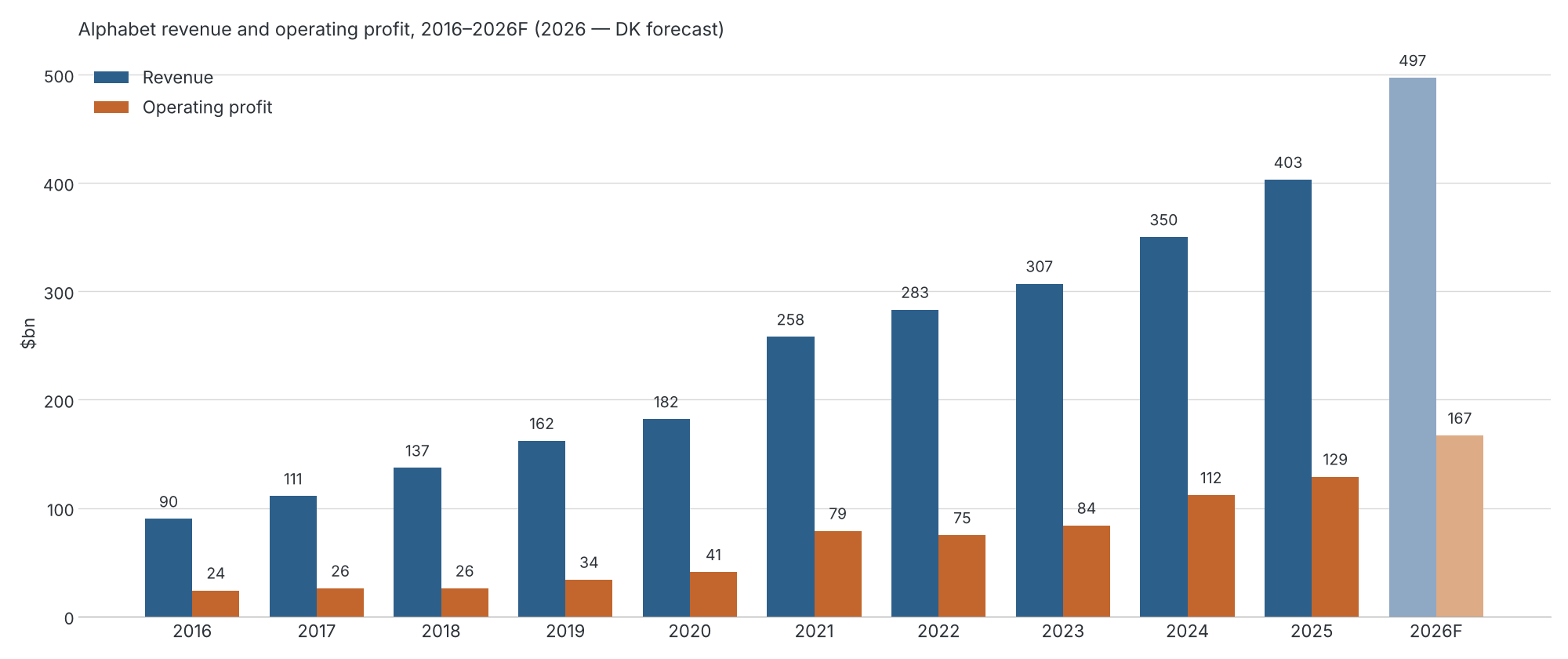
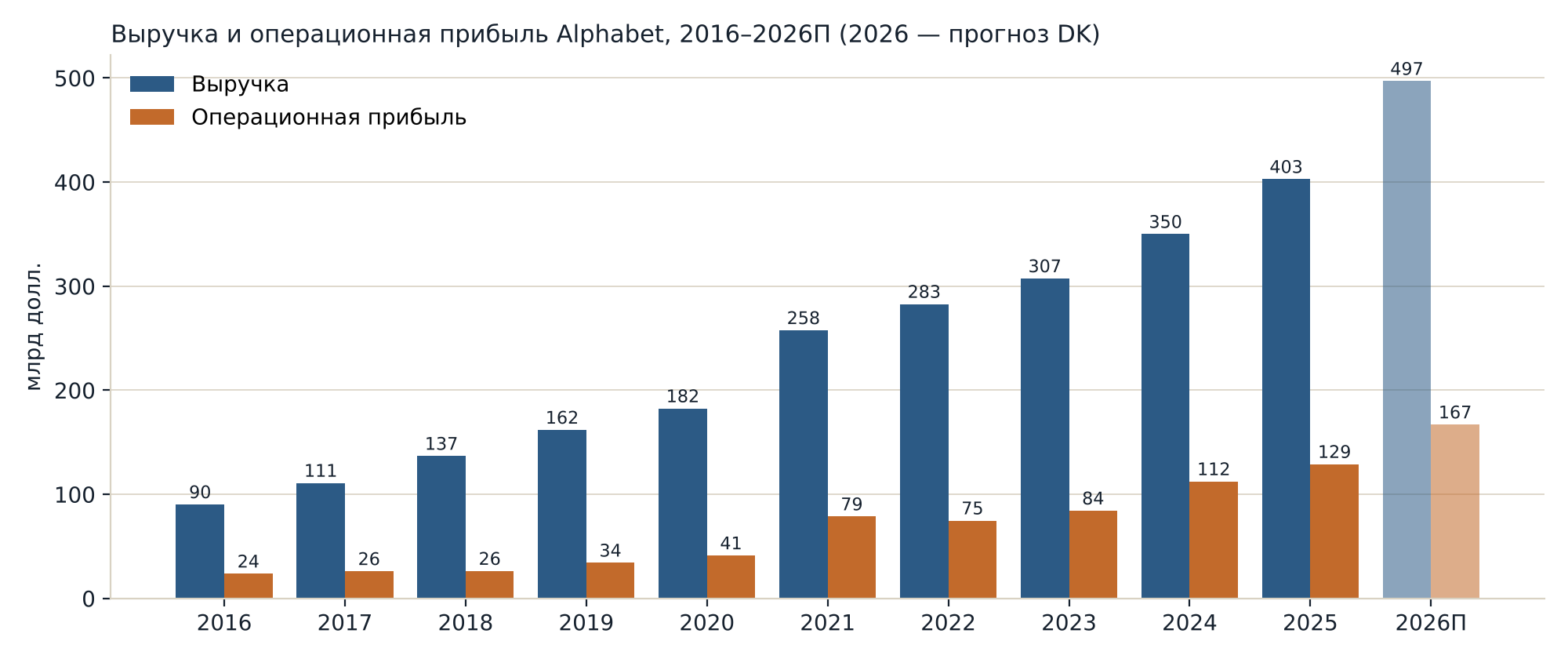
In ten years revenue has grown five and a half times; operating profit, seven. This is the rare case of a company of such size speeding up rather than slowing down: revenue grew 14% in 2024, 15% in 2025 and, on our estimate, about 23% in 2026, to ≈$497bn. Operating profit — what remains after all the costs of running the business itself — rises on our estimate by 29%, to ≈$167bn, a margin of about 33.5%. Put another way, of every three dollars of revenue, one stays with the company as profit from its core operations.
Why this is a good business
First — search survived, then accelerated. Three years ago investors’ great fear was that AI chatbots would replace search. The opposite happened: Google built AI answers into search, people began asking more questions — and harder ones — and, according to management, query growth is now the highest it has been in five years. Search advertising grows 12% a year on a base of $250bn.
Second — the cloud has become the second big business. As recently as 2022 it was loss-making. Today it brings in more than $30bn of revenue a quarter at an operating margin of 36%. Eighteen cloud products each earn more than a billion dollars a year.
Third — its own AI chip. Google has spent ten years developing its TPU processors and now sells entire computing systems built on them to other companies. This is the decisive competitive advantage: those who rent Nvidia’s graphics cards pay Nvidia’s fat margin — Google does not.
Fourth — scale that cannot be copied. The Gemini app has reached a billion users, the fastest-growing product in Google’s history. YouTube has 150m paying subscribers. The company’s models process about 32bn tokens (units of text) a minute — four times more than a year ago.
Fifth — the order book. Cloud customers have already signed contracts worth $561bn, and roughly 55% of that becomes revenue within the next two years.
In Alphabet’s accounts for 2026 you will see a very large profit: $201bn of net income for nine months, nearly double a year earlier. Around $100bn of it, however, is not money earned by the business but the revaluation of stakes in SpaceX and in one private AI company — in all likelihood Anthropic — in which Alphabet invested years ago. Under American accounting rules the rise in their value is booked as profit even though not a single share has been sold. In the third quarter the revaluation swung the other way, and reported earnings per share fell 26% while the business grew 27%. That is why we always look at profit excluding revaluations: on our estimate, about $11.1 per share for 2026 (+27%). It is this figure, not the headline one, that shows what the business itself earns.
Assets and liabilities
In the nine months of 2026 Alphabet’s balance sheet grew from $595bn to $1,003bn — past the trillion mark for the first time.
What the company owns, $bn | |||
Item | 30.09.2026 | 31.12.2025 | In plain words |
|---|---|---|---|
Data centres, servers, equipment | 372.8 | 246.6 | the factories of the new age: buildings full of computers |
Cash and securities | 265.1 | 126.8 | including $90bn of shares, above all SpaceX |
Stakes in private companies | 135.2 | 68.7 | mostly one private AI company, Anthropic |
Owed by customers | 72.8 | 62.9 | revenue recognised, the cash not yet in |
Acquired companies (goodwill) | 66.9 | 34.7 | Wiz (cybersecurity), Intersect (energy) |
Finished-goods inventory | 13.3 | 2.4 | TPU systems assembled for customers |
Total assets | 1,003.3 | 595.3 | |
What the company owes, $bn | |||
Item | 30.09.2026 | 31.12.2025 | In plain words |
|---|---|---|---|
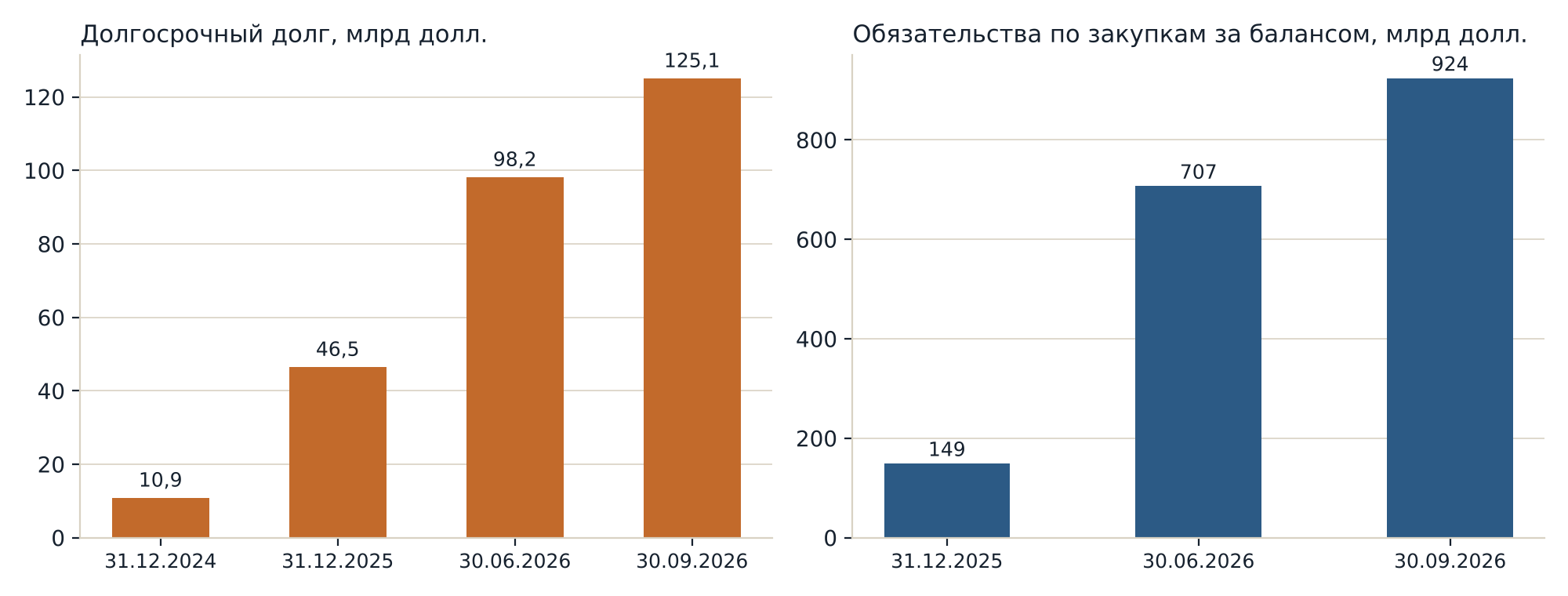
Long-term debt (bonds) | 125.1 | 46.5 | a year earlier it was 10.9 |
Deferred tax | 27.8 | 0.9 | tax on the paper SpaceX profit — due when the shares are sold |
Other liabilities | 172.9 | 132.6 | supplier bills, wages, current payments |
Total liabilities | 325.8 | 180.0 | |
Shareholders’ equity | 677.5 | 415.3 | what belongs to the shareholders |
At first sight the balance sheet looks very solid: more than two dollars of cash and securities for every dollar of debt, and equity twice the size of all liabilities. That is true, and bankruptcy is no threat to Alphabet. But three important movements sit behind these figures.
The company has become heavy. As recently as 2021 Alphabet was a “light” business: software, advertising, a modest fleet of servers. Today 37% of everything it owns is concrete, electricity and computers. Such a business has to keep investing simply to stand still, because computers grow old.
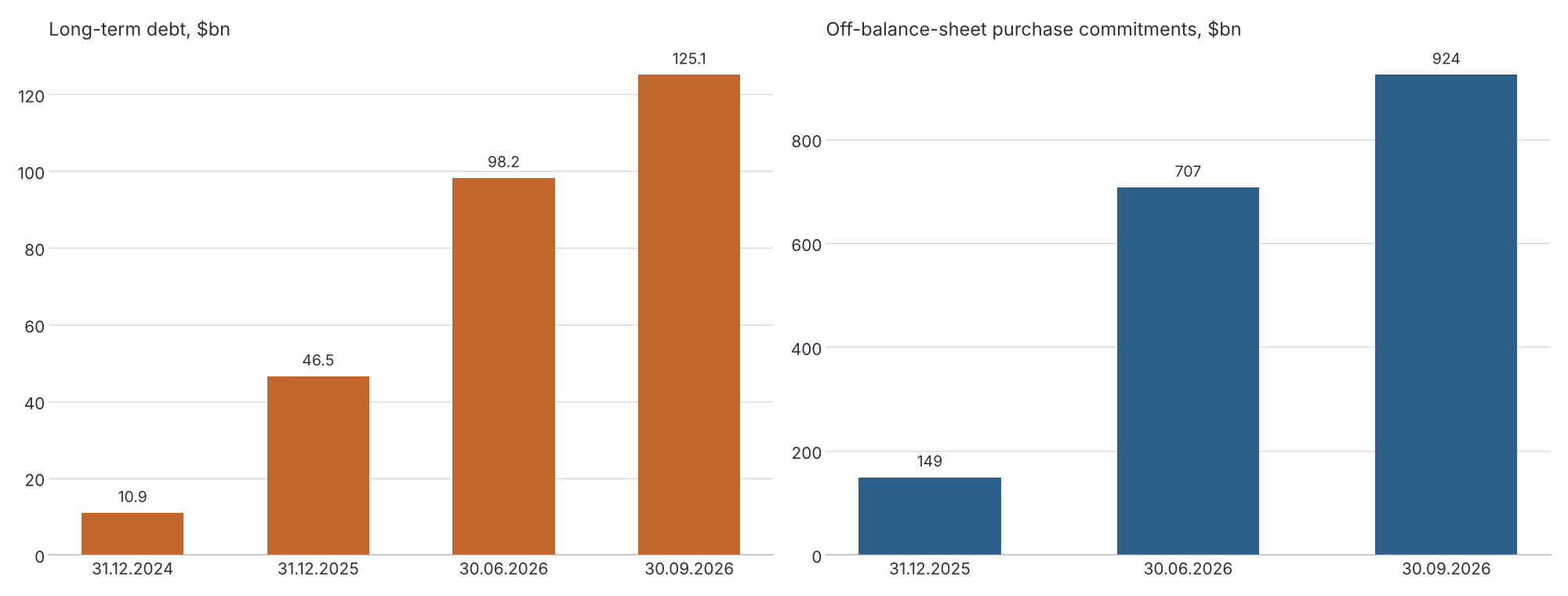
Debt is growing very fast. In nine months it rose 2.7 times, from $46.5bn to $125.1bn. In itself it is small for a company of this size, but the direction matters more than the level: a year ago Alphabet hardly borrowed at all; now it borrows every quarter.
The biggest item sits off the balance sheet. The company has signed contracts for chips, servers and electricity worth $924bn over the years ahead, and another $152bn of data-centre leases and other commitments. Together about $1.08trn — more than everything the company owns. At the end of 2025 such purchase commitments stood at $149bn; in nine months they have grown sixfold. The finance chief is careful to note that these are maximum amounts and that some contracts allow flexibility on volumes. But the meaning is plain: the company has already committed itself to the next four or five years of spending.
Cash flow
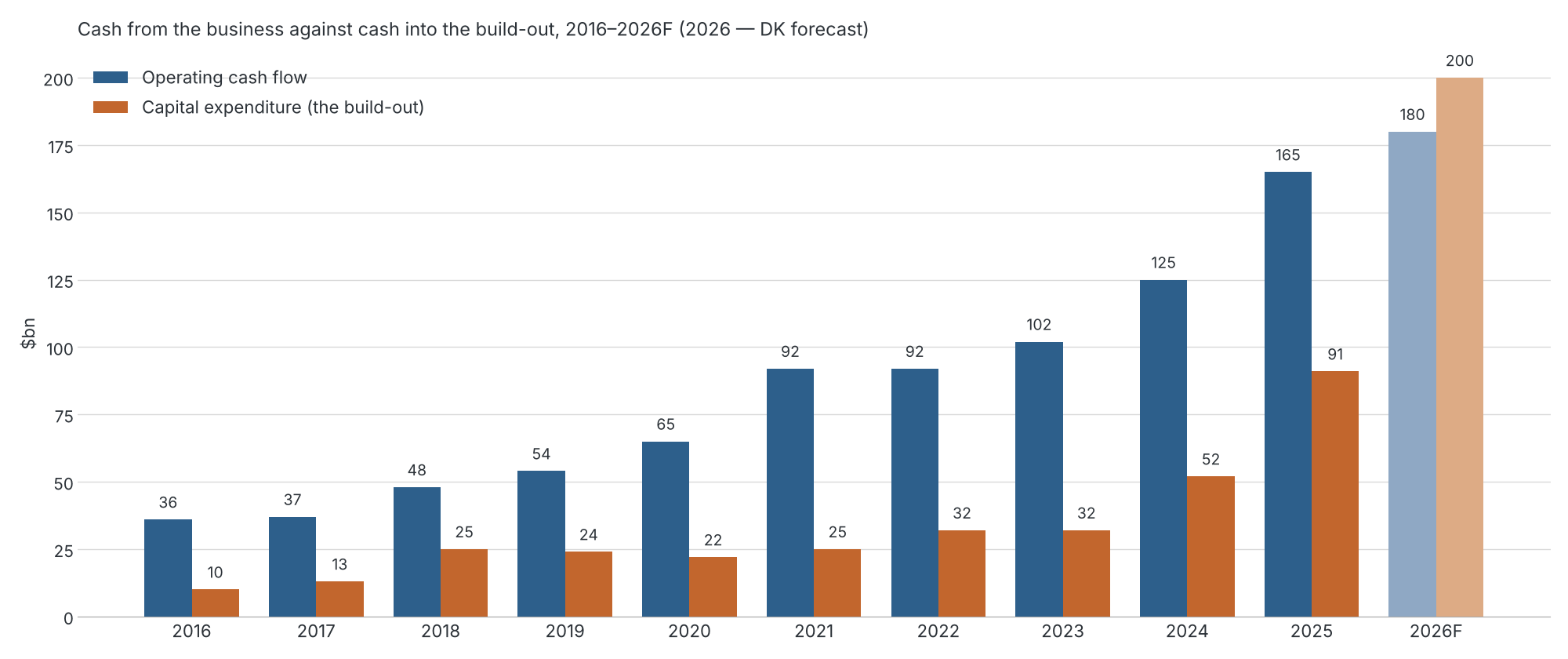
Profit is an accountant’s opinion; cash is a fact. Picture a shopkeeper who has sold a million’s worth of goods on credit: the ledger shows a profit, but there is nothing to pay the rent with. That is why serious investors look beyond profit to operating cash flow — the actual money the business collected from customers, net of all running payments. From it they subtract capital expenditure — the money spent on new equipment and buildings. What is left is free cash flow: money that can be returned to the owners without touching the business.
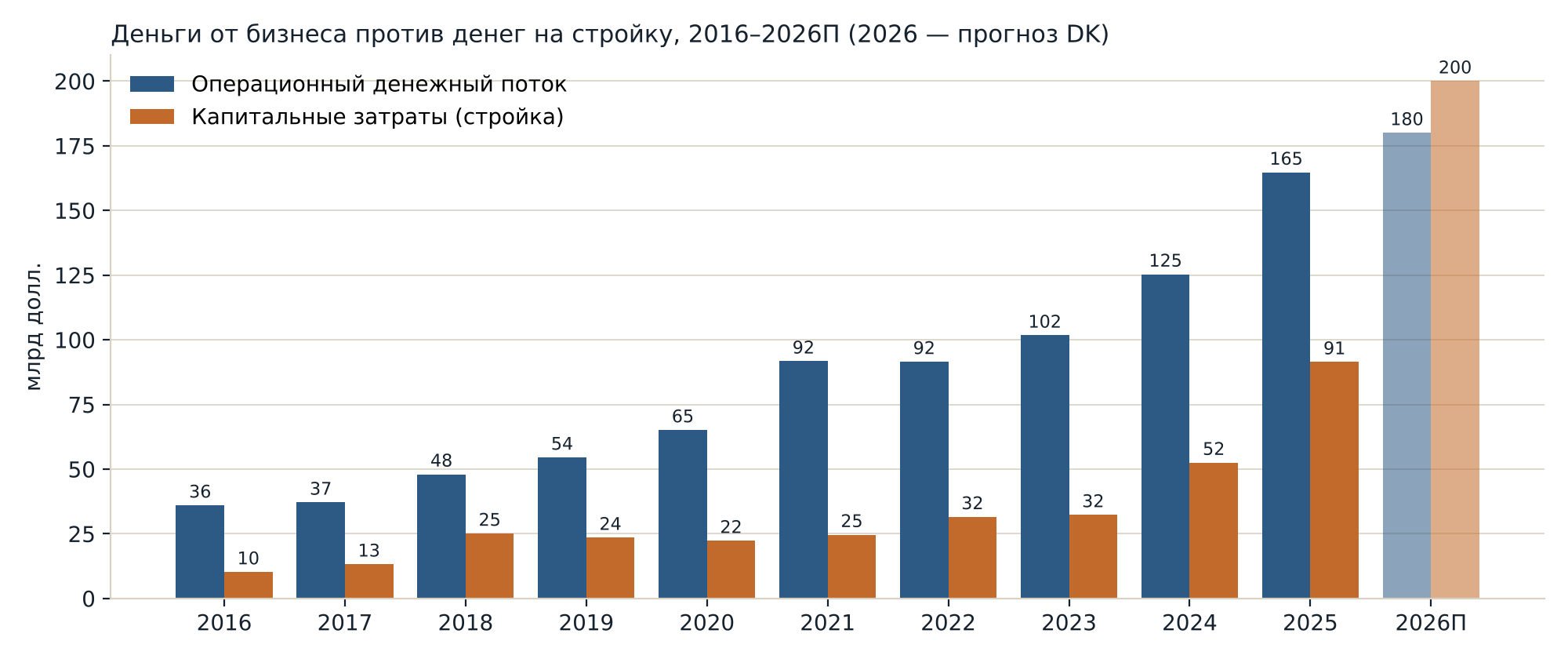
For twenty years Alphabet was a model machine for producing free cash. In 2025 the business generated $164.7bn of operating cash flow, $91.4bn went on the build-out, $73.3bn was left free — and almost all of it went back to shareholders as buybacks and dividends. In 2026 the picture has turned upside down.
The quarters, $bn | |||||
Q3 2026 | Q2 2026 | Q1 2026 | Q4 2025 | Q3 2025 | |
|---|---|---|---|---|---|
Operating cash flow | 42.3 | 39.1 | 45.8 | 52.4 | 48.4 |
Capital expenditure | 51.4 | 44.9 | 35.7 | 27.9 | 24.0 |
Free cash flow | −9.1 | −5.9 | 10.1 | 24.6 | 24.5 |
Free cash flow, trailing 12 months | 19.7 | 53.3 | 64.4 | 73.3 | 73.6 |
For two quarters running, the build-out has cost more than the business earns in cash. In a year free cash flow has fallen from $73.6bn to $19.7bn, and for 2026 as a whole we put it at about minus $15bn — the first such year in the company’s modern history. Capital expenditure, meanwhile, will reach $195–205bn this year and, in management’s words, will rise “significantly” in 2027.
Why is operating cash flow not growing with revenue? This is perhaps the most troubling observation. Third-quarter revenue rose 25% and profit 30%, while operating cash flow fell 13%. There are three explanations. First, the company at last paid the European Commission’s fine of 2018 — $5.2bn. Second, it is stocking its warehouse with TPU systems for sale to customers: inventory grew from $2.4bn to $13.3bn in nine months — the money has been spent, and comes back only on delivery. Third, prepayments to suppliers and growing customer receivables. Even without the fine, the quarter’s cash flow did not grow (−2%). The “core” of the flow — profit without paper revaluations, plus depreciation — is growing by a third, but more and more of the money is stuck in inventory and prepayments. A business that used to be paid up front now pays up front itself.
There is also a hidden buffer that flatters the picture for now. At 30 June the company had $29bn of unpaid bills for equipment already delivered — the suppliers are, in effect, financing the build-out. While construction grows, that credit grows with it. But the day the company decides to slow down, those bills will fall due — exactly when there is less money around.
Borrowings and new capital
Money raised from investors, $bn | ||
9M 2026 | 9M 2025 | |
|---|---|---|
New bonds, net of redemptions | +76.3 | +11.9 |
Sales of new shares, including the ATM programme | +42.9 | 0 |
Convertible preferred shares | +19.1 | 0 |
Buybacks of the company’s own shares | 0 | −39.8 |
Net raised from investors | +138.3 | −27.9 |
A company that for ten years was the biggest buyer of its own shares — nearly $350bn of buybacks between 2015 and 2025 — turned seller in the first nine months of 2026. It halted the buyback, issued $62bn of new stock (including the $10bn bought by Berkshire Hathaway) and borrowed $85bn. The share count is up 1.7%, with another $27.6bn still available under the at-the-market sales programme. For a shareholder this means that, for the first time in a decade, his stake is being diluted rather than concentrated.
If the $924bn of purchase commitments really is performed by 2030, that is $210–230bn of spending a year against $180–200bn of operating cash flow. Which means the build-out will go on being paid for with debt and new shares. On our estimate, debt reaches roughly $200bn by the end of 2027.
What management says — and what it does not
Management presented the third-quarter report in a very optimistic key, and it has grounds for that. A few verbatim quotations from the investor call of 29 October 2026:
“Our year-over-year query growth rate is the highest it’s been in the last 5 years.” — Sundar Pichai, CEO
“The Gemini app is now at 1 billion users and is the fastest-growing product in Google’s history.” — Sundar Pichai
“Throughout this investment cycle, we expect to generate an attractive ROIC that remains meaningfully above our cost of capital and anticipate generating strong cash flow from operations.” — Anat Ashkenazi, CFO
“Our sizable investments in technical infrastructure and inventory build of TPU systems as we scale that business will put pressure on free cash flows.” — Anat Ashkenazi
The chief executive called 2027 a “golden year” of productivity: the new Gemini 4 models are already changing how Google’s own engineers work, and AI agents — programs that do not merely answer but carry out tasks, up to and including purchases — are coming to Search and to Gemini. We do not doubt the products. They are impressive.
But notice what was not said. Not one figure for the return on the capital invested. No payback period. No guidance for free cash flow. Management is confident the returns will come, and it may well be right. But when a company takes on commitments worth more than everything it owns, one would like to see the arithmetic, not only the confidence. Buffett has long advised reading executives’ letters as much for what they leave out as for what they say.
The risks
The first and main risk — who ultimately pays for AI. A large part of today’s demand for cloud computing comes not from ordinary companies but from AI laboratories such as Anthropic. They spend more on computing than they earn, and they live on the money of venture and private funds. The $561bn order book looks imposing, but much of it will be paid by customers who have no profits yet. While the funds keep giving, the orders grow. If the funds stop — the orders get revised.
The second — computers age faster than they are written off. The company spreads the cost of its servers over six years (that is depreciation — the annual charge for wear). But AI accelerators become obsolete in three or four years, like smartphones: each new generation is several times more powerful, and the old one gets cheap. Depreciate the capital spending of 2026 over three years instead of six, and the annual charge rises from ≈$33bn to ≈$67bn, while the cloud margin falls from about 33% to about 18%. Depreciation is already growing 49% a year against revenue growth of 25%.
The third — from a light business to a heavy one. In 2021 the build-out took 10% of revenue; today, 40%. Heavy businesses — airlines, steel, telecoms — have historically traded cheaper on the stock market than light ones, because they must keep investing merely to keep up. And the competitors — Microsoft, Amazon, Oracle, Meta — are building the same thing at the same time. When everyone adds capacity at once, the price of computing falls.
The fourth — paper wealth. About $226bn — nearly a quarter of all assets and a third of equity — is shares in SpaceX and in one private AI company (Anthropic). Their value is remeasured every quarter, and in the third quarter it fell by $8.7bn. A 30% fall would take about $53bn off net profit — more than the cloud earns in a year.
The fifth — dilution and debt. The buyback is gone, new shares are being issued, debt is growing. Every quarter of this regime slightly shrinks each shareholder’s claim on future profit.
The sixth — the regulators. The US Department of Justice and the European Commission have spent years contesting Google’s position in search and advertising. The company has just paid a $5.2bn fine. Rulings in the search and ad-tech cases could change the terms on which Google gets its traffic.
A pessimistic but entirely possible scenario
Technology cycles resemble one another. Railways in the nineteenth century, telecoms and the internet in the 1990s — each time the new technology really did change the world, but investors built capacity faster than paying demand appeared, and between the euphoria and the payback came a painful pause. We do not know whether AI will have such a pause. But if it does, it will reach Alphabet in three blows.
The chain runs like this. First comes disappointment: the products are wonderful, but the AI laboratories still make no money, and their investors demand payback. Then the taps close: venture and private funds cut their financing, and money for start-ups gets dearer. Here Alphabet takes the first blow — the write-down: the SpaceX and private AI stakes fall in value, and billion-dollar investment losses appear in the accounts. The second blow — demand: start-ups cut their computing purchases, the order book is revised, the TPU inventory does not sell. The third blow — profit: the capacity stands idle, but the depreciation and the $924bn of contracts do not go away, so the cloud margin and the cash flow fall. The market stops seeing Alphabet as the “AI winner” and starts pricing it as a heavy infrastructure company.
2027 in two scenarios, $bn (DK estimates) | ||
Base case | “AI winter” | |
|---|---|---|
Revenue | ≈590 | ≈520 |
of which Google Cloud | ≈165 | ≈105 |
Operating profit of Google Services (Search, YouTube, subscriptions) | ≈170 | ≈165 |
Operating profit of Google Cloud | ≈55 | ≈ −10 |
Other Bets and group-wide AI research | ≈ −38 | ≈ −36 |
Operating profit, total | ≈187 | ≈119 |
Earnings per share excluding revaluations, $ | ≈12.3 | ≈7.8 |
How many years of profit the market pays (P/E) | 24 | 18 |
Share price, $ | ≈295 | ≈140 |
Look carefully at the third row. Even in the “winter”, Search, YouTube and subscriptions go on earning about $165bn a year. What breaks is not the core business but the cloud superstructure and the market’s mood. And that is exactly the situation for which a patient investor keeps money ready: a wonderful business temporarily selling at the price of a mediocre one, because everyone is staring at the new part’s problems and forgetting the old part’s strength.
The shares against the bond
The simplest way to judge whether a share is dear is to imagine it as a bond. Pay $279.84 for the share while the business earns $10.53 of profit on it a year (excluding paper revaluations, trailing twelve months), and your “yield” is 3.8%. A 10-year US government bond pays 4.93% today — with no risk at all. The buyer of the share is settling for less than the government pays, in exchange for the hope that the profit will grow quickly.
The share as a bond | |||
Per share | $ | Price ÷ figure | Yield |
|---|---|---|---|
Reported earnings, 12 months (with revaluations) | 19.15 | 14.6 | 6.8% |
Business earnings excluding revaluations, 12 months | 10.53 | 26.6 | 3.8% |
Business earnings excluding revaluations, 2026 forecast | ≈11.1 | 25.2 | 4.0% |
Free cash flow, 12 months | 1.60 | 175 | 0.6% |
Dividend | 0.88 | 0.3% | |
10-year US Treasuries | 4.93% | ||
The reported price-to-earnings ratio of 14.6 looks cheap, but it deceives: nearly half the reported profit is the revaluation of investments. On the business’s real profit the share costs 26–27 years of earnings. That is a fair price for a company that will grow 15–20% a year for many years to come. But it is not a price with a margin of safety — the gap between price and value that protects the investor when something goes wrong.
What a given price would mean | |
Share price, $ | What it means |
|---|---|
≈280 (today) | paying for growth in advance: the yield is below government bonds |
≈250 | 2027 earnings (base case) yield as much as the government bond |
≈225 | 2026 earnings yield as much as the government bond |
160–180 | a good price: two percentage points above the bond — payment for the risk |
≈140 | the price of the “AI winter” scenario |
Alphabet stays on the list of companies we want to own. $280 is not the market’s mistake; it is a bet that the build-out pays off, and we see no reason to make that bet at our own expense without a discount. We regard $160–180 as the sensible buying point: there the investor is paid a real premium for the risk, and such a price could well appear at the first serious disappointment in AI. If instead the cycle passes smoothly and profit grows as management promises, we shall miss part of the rise — and that is the price of discipline we are willing to pay.
What to watch each quarter
The good news is that the answer to the main question will show up in the accounts before it shows up in the headlines. Here are eight signals we will be checking in every quarterly report.
Eight signals | |||
Signal | Now | Warning | Confirmation of success |
|---|---|---|---|
Operating cash flow, trailing 12 months | $179.6bn | below 175 | above 230 by the end of 2027 |
Build-out as % of cash flow | 121% | above 100% for three quarters running | below 80% |
Inventory of TPU systems | $13.3bn | grows while cloud revenue does not | sells down |
Advances from customers | $9.4bn | stop growing | grow: customers paying up front |
Cloud order book | $561bn | slowdown or revision | growth, with the payments to match |
Server life in the accounts | 6 years | any extension | shortened without the margin falling |
Debt and sales of new shares | $125.1bn | issuance accelerates | the buyback resumes |
Valuations of SpaceX and the AI labs | ≈$226bn | write-downs, failed funding rounds | stable rounds |
The bottom line
Alphabet is a wonderful business. Search, YouTube and subscriptions bring in more than $150bn of operating profit a year and, against all the fears, are accelerating thanks to AI. In three years the cloud has gone from loss-making to one of the fastest-growing and most profitable businesses in the world. Its own chips give the company an advantage almost no one else has.
But in 2026 this company stopped being a machine for handing out money and became a builder. It spends more on construction than it earns in cash, borrows and sells new shares, and its obligations to suppliers have passed a trillion dollars. All of this is justified — provided the cloud’s customers, in large part loss-making AI laboratories, can pay their contracts. Management is sure they can, but shows no arithmetic.
We are not betting against Alphabet, and we are not betting on it at today’s price. We are waiting. As Buffett says, there are no called strikes in the stock market: you may let pitch after pitch go by until the one you want arrives. Ours is a wonderful business at $160–180 a share.
This note is a plain-language summary of the five parts of the Alphabet financial analysis — equity, assets, liabilities, the income statement and cash flows — published on DK Research. Data: Alphabet’s accounts (Forms 10-K, 10-Q and the quarterly releases) and the transcript of the investor call of 29 October 2026; the forecasts, scenarios and price zones are the author’s estimates. This material is not investment advice.